- English
- Español
- Português
- русский
- Français
- 日本語
- Deutsch
- tiếng Việt
- Italiano
- Nederlands
- ภาษาไทย
- Polski
- 한국어
- Svenska
- magyar
- Malay
- বাংলা ভাষার
- Dansk
- Suomi
- हिन्दी
- Pilipino
- Türkçe
- Gaeilge
- العربية
- Indonesia
- Norsk
- تمل
- český
- ελληνικά
- український
- Javanese
- فارسی
- தமிழ்
- తెలుగు
- नेपाली
- Burmese
- български
- ລາວ
- Latine
- Қазақша
- Euskal
- Azərbaycan
- Slovenský jazyk
- Македонски
- Lietuvos
- Eesti Keel
- Română
- Slovenski
- मराठी
- Srpski језик

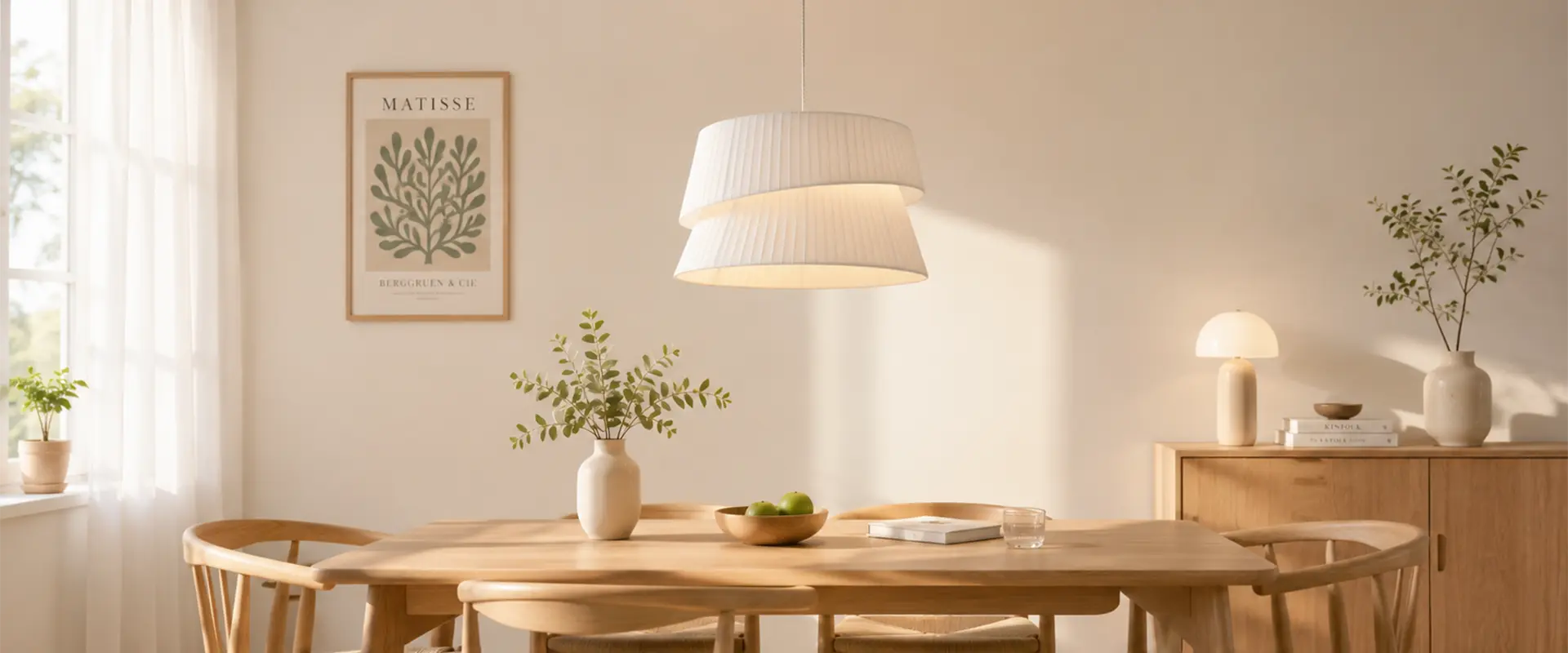
The Benefits of Stocking a Three-Color Pleated Pendant Light Collection
A coordinated pendant family can reduce assortment sprawl. Instead of sourcing unrelated fixtures for warm, muted, and neutral interiors, you can offer three colors and two shade sizes while keeping the pleated drum form, iron construction, and satin-brass details consistent.
That makes the Pleated Fabric Pendant Light 3 Colors collection useful for retailers, importers, e-commerce sellers, designers, and project buyers. The commercial benefit, however, depends on confirming the exact color-size combinations, electrical configuration, US compliance status, and order terms before committing inventory.
One Coordinated Collection Can Simplify Assortment Planning, Merchandising, and Project Specification
Shared design details let you build a color and size story without introducing a different visual language for every SKU. Terracotta, sage green, and off-white can be photographed together, displayed as a family, or assigned to different room schemes. The 450 mm and 600 mm shades give buyers two scale choices within that same presentation.
For project specifications, this continuity can make it easier to repeat a pendant across dining areas, bedrooms, lounges, or hospitality spaces while adjusting color or diameter. For retail, it creates opportunities for coordinated product pages and swatch-led merchandising. It doesn’t eliminate SKU management: each approved color, size, lampholder arrangement, and market-specific electrical version still needs a distinct item record.
Compare the Three Colorways and Two Shade Sizes on Like-for-Like Criteria
Judge the range as a matrix rather than as six automatically interchangeable options. Start with intended setting, perceived scale, fabric appearance under light, and the combinations the factory can actually supply.
| Option | Best evaluated for | Buyer check |
|---|---|---|
| Terracotta | Warm, earthy palettes and stronger color contrast | Review a physical sample under the intended lamp and room lighting |
| Sage green | Muted green schemes, including restrained Japandi-inspired interiors | Check how the fabric coordinates with wood, paint, and upholstery samples |
| Off-white | Neutral assortments and broader material coordination | Confirm the actual undertone rather than relying on a screen image |
| 450 mm shade | Locations where the smaller drum is visually proportionate | Verify overall fixture dimensions and suspension details |
| 600 mm shade | Larger tables, rooms, or groupings needing more visual presence | Confirm weight, canopy, support, carton size, and freight impact |
Terracotta, Sage Green, and Off-White: Design Character, Coordination, and Color-Sample Checks
A terracotta pleated pendant light brings more visible color than the off-white version; sage green sits between a neutral and a statement shade. Those are design distinctions, not guarantees of an exact hue. Fabric weave, dye lot, lamp color temperature, daylight, and screen calibration can all change how the shade appears.
Approve production against a signed physical sample or agreed color reference. Ask how color variation is controlled between orders, especially if replenishment stock must sit beside an earlier batch.
450 mm and 600 mm Drum Shades: Nominal 18-Inch and 24-Inch Formats
The stated shade options convert to approximately 17.7 inches and 23.6 inches, so they can be merchandised as nominal 18-inch and 24-inch formats where appropriate. Keep the metric dimensions in technical records; rounded inch labels shouldn’t replace factory drawings.
Diameter alone isn’t enough for specification. Request shade height, complete drop range, canopy dimensions, stem or suspension configuration, fixture weight, and packed-carton measurements. Those details affect placement, installation, storage, parcel eligibility, and freight cost.
Shared Pleated Fabric, Iron, and Satin-Brass Details Support Residential and Hospitality Schemes
The pleated fabric creates visible texture, while the drum shape maintains a consistent profile across the range. An iron body and satin-brass finish provide a common metal detail that can coordinate with warm hardware and furniture accents. This is more useful than six unrelated products because buyers can change color or scale without abandoning the collection’s basic design.
Fabric also has trade-offs. It can collect dust, may show handling marks, and isn’t the default choice for wet, greasy, or high-maintenance locations. Hospitality buyers should verify cleaning guidance, fabric performance requirements, flame-related documentation required by the project, and whether replacement shades are available. IP20 classification does not provide water protection.
Technical Details US Buyers Must Resolve Before Ordering
A visually suitable pendant isn’t automatically ready for the US market. Obtain a model-specific specification sheet, drawing, bill of materials, labeling details, and compliance evidence for the exact version you intend to buy.
Confirm the Model-to-Color-to-Size Mapping and Resolve the Single- Versus Five-Lampholder References
Product references indicate E14 lampholders, but the available information also contains single- and five-lampholder references. Treat that as an open specification issue, not a selectable feature, until Strong Lighting confirms which construction applies to each model, shade size, and color.
The answer changes bulb quantity, wiring, light output planning, replacement-bulb cost, labeling, and photography. Your purchase order should identify the approved socket count and include the matching drawing; a family-level description is not precise enough.
Verify Voltage, E14 Bulb Suitability, Canopy and Junction-Box Compatibility, IP20 Placement, Installation Documents, and Complete-Fixture UL or ETL Listing Status
- Electrical rating: Confirm input voltage, frequency, socket rating, maximum permitted lamp wattage, grounding method, cord or stem details, and dimmer compatibility where required.
- E14 bulbs: E14 describes the base, not the operating voltage or suitability of a lamp. Confirm that compliant replacement bulbs are practical for your US customer and fixture configuration.
- Mounting: Check canopy dimensions, mounting hardware, junction-box compatibility, fixture support requirements, and installation instructions.
- Location: IP20 is an indoor classification without water protection. Don’t specify it for damp or wet locations unless a separately documented version is supplied and approved.
- Certification: Ask whether the complete fixture—not merely individual electrical components—is listed or certified for the intended US market by UL, ETL, or another acceptable nationally recognized testing laboratory. Request documentation tied to the exact model.
Mixed Orders, Samples, Custom Colors, Stem Changes, and Private-Label Packaging Add Wholesale Flexibility
Strong Lighting offers OEM and ODM service, samples, mixed orders, custom colors, stem changes, and private-label packaging. These options can help a wholesale buyer test several colorways, align the fixture with a house collection, or prepare retailer-specific cartons.
Customization also creates more approval work. A new fabric color, altered stem, different electrical package, or branded carton may affect minimum quantities, price, lead time, testing scope, carton markings, and replacement-part planning. Use a pre-production sample and written specification rather than approving a change through images alone. The three-color pleated pendant range provides the starting configuration for that discussion.
Stocking Decision Checklist: MOQ, Sample Terms, Lead Time, Color Consistency, Export Packing, Shipping Terms, Warranty, and Compliance Evidence
- Get the MOQ by color, size, electrical version, and packaging format—not only a collection-wide MOQ.
- Confirm sample price, freight, production status, approval process, and whether the sample reflects final electrical components.
- Separate sample, production, customization, testing, and transit lead times.
- Set an approved color standard and ask how repeat-order variation will be handled.
- Review export packing, carton dimensions, drop-test information if available, spare-parts packing, and shade-protection methods.
- State the Incoterm, shipping point, payment terms, inspection arrangement, and responsibility for duties and domestic delivery.
- Document warranty coverage, exclusions, claim evidence, replacement-part availability, and remedy for transit damage.
- Match drawings, ratings, labels, test reports, and listing records to every ordered model.
If those points fit your channel and risk requirements, use the pleated fabric pendant light product page to request current samples, order terms, configuration details, and compliance documents.